

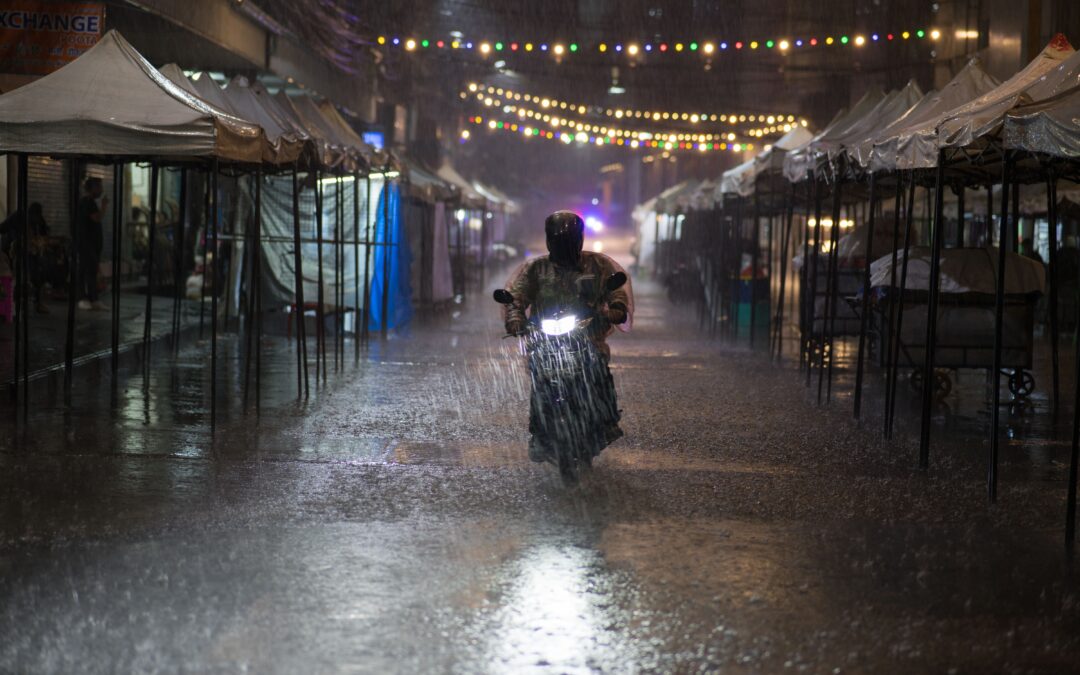
Does Phuket flood in rainy season? Yes, in a handful of recurring spots, and mostly as flash floods that drain within hours. Rainy season runs from about mid-May to October and stays wet through November. The bigger risk for families is landslides on steep slopes, which is why the house you rent matters more than the month you arrive.
Correct as of 3 November 2026
This guide is for people who live here or are about to. It covers the real rainfall data, the places that flood year after year, and what to check before you sign a lease.
Table of Contents
✦ Key takeaways
- Rainy season runs mid-May to October. November is still wet, and September and October are the heaviest months.
- Flooding is local and usually short. The same roads and estates flood most years, and main roads tend to clear within hours.
- Landslides are the serious risk. Before you rent, look at what sits above the house, not just what sits around it.
- Warnings come straight to your phone. Thailand’s Cell Broadcast alerts need no app, and Phuket received several in October 2026.
- The new government scheme covers buildings, not belongings. If you rent, your things are only covered by your own policy.
When Is Rainy Season in Phuket
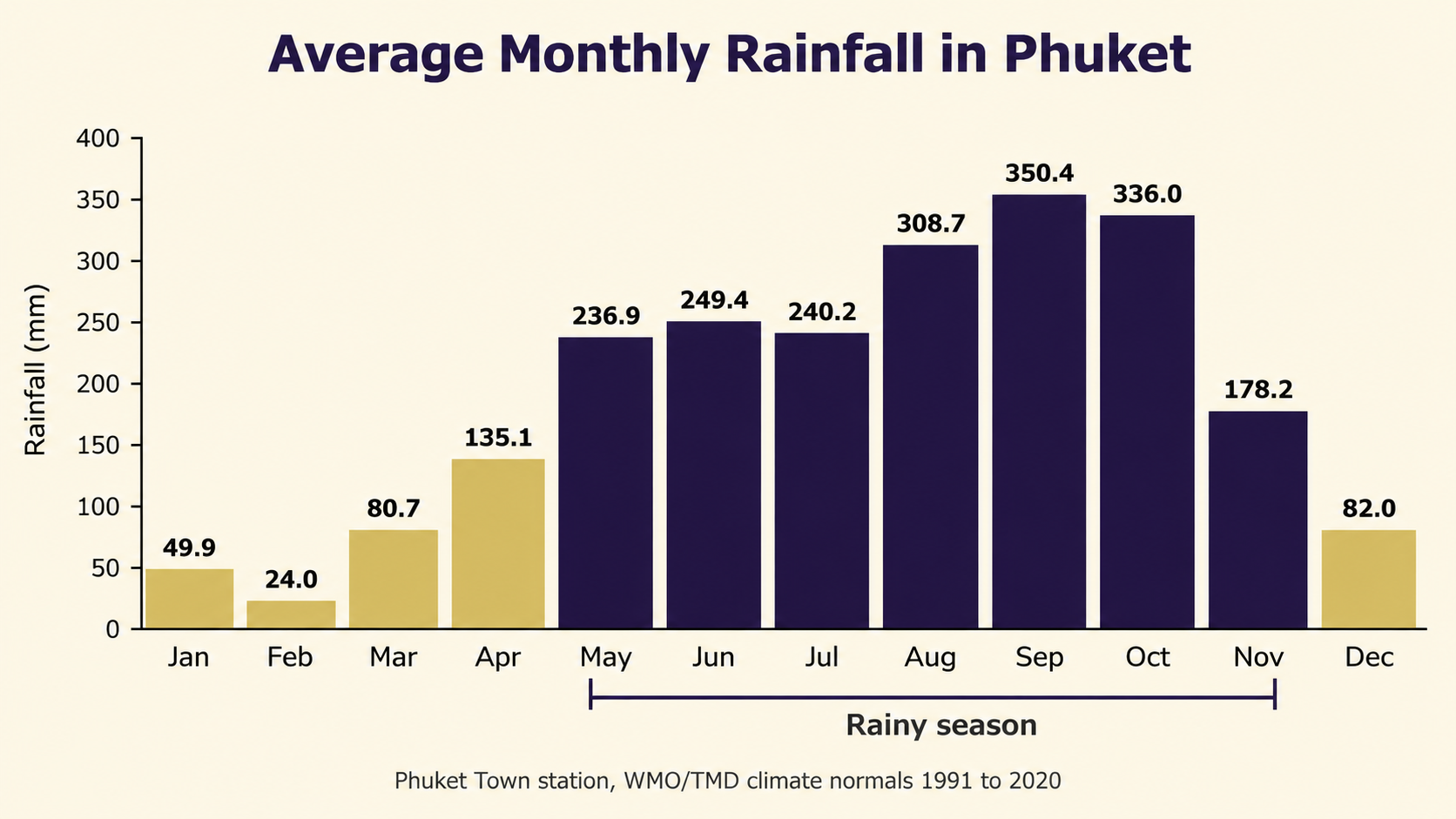
The Thai Meteorological Department (TMD) dated the start of the 2026 rainy season to 15 May. In practice that’s the pattern most years. Rain builds through May, stays heavy through the summer, peaks in September and October, then eases off through November.
Here’s what an average year looks like, using official 30-year figures for Phuket.
| Month | Average rainfall (mm) | Days with rain |
|---|---|---|
| January | 49.9 | 4 |
| February | 24.0 | 2 |
| March | 80.7 | 6 |
| April | 135.1 | 10 |
| May | 236.9 | 16 |
| June | 249.4 | 16 |
| July | 240.2 | 16 |
| August | 308.7 | 17 |
| September | 350.4 | 19 |
| October | 336.0 | 19 |
| November | 178.2 | 13 |
| December | 82.0 | 8 |
| Year | 2,271.5 | 146 |
Phuket Town station, WMO/TMD climate normals 1991 to 2020. A rain day is a day with at least 1 mm.
September brings the most rain by volume and October has the most rainy days. Even at the peak, though, rain falls on 16 to 19 days a month. That leaves a third to half of your days with less than a millimetre.
Averages hide how lumpy recent years have been. October 2025 brought 508.2 mm against a 30-year average of 336 mm. In May 2026, Phuket Airport recorded 670.5 mm, almost 400 mm above normal, and Thalang set a new May record. The same 2025 season also had a dry July and a dry September. Expect extremes rather than a smooth curve.
In my experience, mornings were usually clear and the rain arrived in the afternoon, in short heavy bursts rather than all day. October and November were the worst months I lived through. In November it poured most days and there was a lot less sunshine, but it stayed around 30°C. It won’t be the same every year, so treat the table as a guide, not a forecast.
Why Is It So Rainy in Phuket?
Phuket’s west coast faces the Andaman Sea. From around mid-May the southwest monsoon pushes moist air in off that sea, and that brings the season’s rain. When the winds shift later in the year, the island dries out and the dry season takes over from December.
Is November Still Rainy Season?
Yes, though it’s on its way out. November averages about 178 mm over 13 rainy days, half of October’s total but more than double December’s 82 mm. The November I lived through was heavy, with rain most days.
The official end of the season can be confusing. TMD declares the start of winter based on conditions in upper Thailand, not the South. As of 2 November 2026 it hadn’t declared it yet, and that same day it issued a heavy-rain advisory for the South.
If you’re moving in November, plan for a wet moving day and leave slack in your schedule. It’s also a good month to view houses, because you’ll see how a property copes after rain (see the rental checklist below).
Where Does Phuket Flood
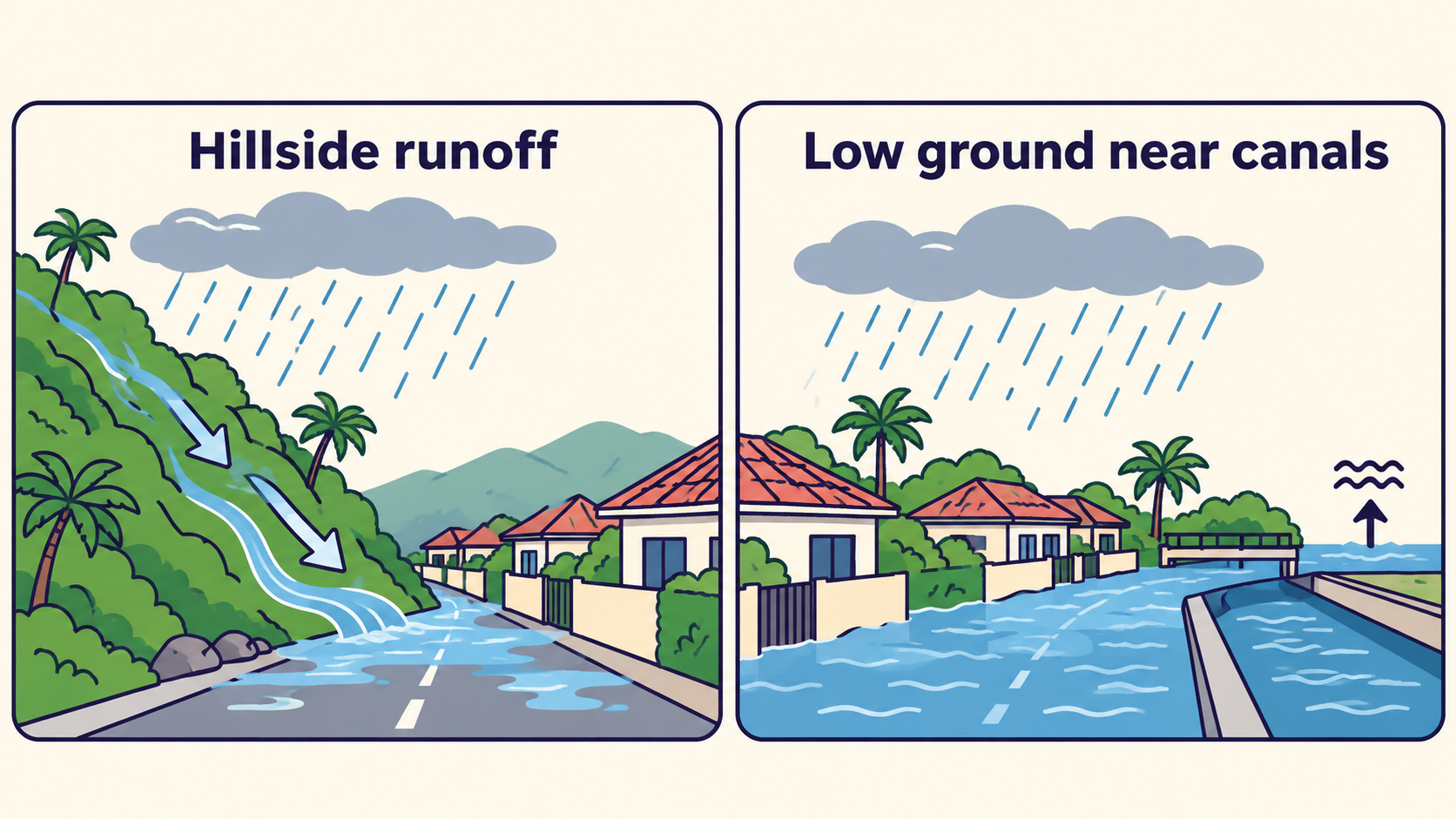
Flooding in Phuket follows two patterns. The first is runoff. Heavy rain pours off steep hills into the streets and homes at the bottom of them. The second is low, flat ground near canals, where the water has nowhere to go, especially when heavy rain meets a high tide.
The same places come up again and again in local reporting.
| Area | Years with reported flooding | What usually happens |
|---|---|---|
| Patong (Na Nai area) | 2022, 2024, 2025, 2026 | Runoff from the hill, mud and debris in the streets |
| Phuket Town and Bang Yai canal | 2022, 2024, 2025, 2026 | Low-lying roads flood when the canal rises |
| Kamala | 2022, 2024, 2025 | Hillside runoff, sand and soil into homes |
| Cherng Talay and Pasak | 2024, 2025, 2026 | Low-lying roads and estates |
| Thepkrasattri Road and Si Sunthon estates | 2022, 2024, 2026 | Flat housing estates that hold water |
| Chalong (around Wat Tai and Chao Fa roads) | 2024, 2025, 2026 | Low roads, too deep for small vehicles |
| Kathu and Loch Palm | 2022, 2024, 2026 | Mountain runoff and small landslips |
It’s usually specific roads, sois and estates that flood, not whole districts. Two houses five minutes apart can have completely different rainy seasons.
Patong
The Na Nai area sits below Khao 50 Pi hill, and when rain is heavy enough the hill empties into it. At about 3am on 26 October 2026, water carrying rocks, soil and mud came down into Na Nai after a night of rain, damaging homes, shops and cars. Ban Na Yai recorded 117 mm in 24 hours. Three temporary shelters opened, and by the 8am assessment the water had gone. The mud took days to clear. No casualties were reported.
For a ground-level look at how these flash floods affect local streets, check out this
Phuket Town and Bang Yai Canal
Bang Yai canal runs more than 20 km from Kathu through Phuket Town to Phuket Bay, and when it rises the low roads around it go under. On 1 July 2026 it rose by more than 3 metres. On 29 October 2026 Phuket City Municipality issued a red alert at 7:40am, telling people along the canal to move belongings and appliances up off the floor.
Why It Keeps Happening
Officials give the same reasons year after year. Heavy bursts of rain overwhelm drains and canals that are too narrow or blocked. Housing estates now cover land that used to soak up the water. Hillsides send runoff straight down, and high tides slow the water’s escape. In April 2026 officials reviewed ฿88.5 million of canal and flood works, including ฿35 million for Bang Yai canal. Until those are finished, expect the same spots to flood.
I saw this for myself. The built-up areas, Thalang and Patong especially, got it noticeably worse than greener parts of the island, because there’s so little open ground left to soak the water up. It’s the same problem Bangkok has, on a smaller scale. Some of the worst flooding I saw was in the back streets of Kamala. What frustrated me most was the response. In some areas the drainage simply isn’t there, and the water has nowhere to go.
How Long It Lasts
Main roads usually clear within hours, often by the same day. Low-lying estates are the exception. In July 2024, parts of Thepkrasattri were still under water the following day. The lasting damage is usually mud, ruined belongings and flooded cars rather than standing water. This is not the weeks-long river flooding you see in central Thailand.
That doesn’t make it trivial. I’ve seen water knee-deep and higher, and the damage to roads, cars and houses is real.
Landslides in Phuket
Flooding is the inconvenience. Landslides are the danger.
On 23 August 2024, after a night of heavy rain, slides came down from the Nakkerd hills onto Soi Patak 2 in Karon. Locally it’s also called the Kata or Big Buddha landslide. Thirteen people died and 19 were injured. 209 households across nine villages were affected, and more than 50 houses and rental rooms were destroyed. Some of the homes buried were rentals.
The cause is still disputed. In January 2025 the Department of Mineral Resources listed new construction at the Big Buddha viewpoint as a contributing factor. In June 2025 police dropped the case after geotechnical officials called it a natural event.
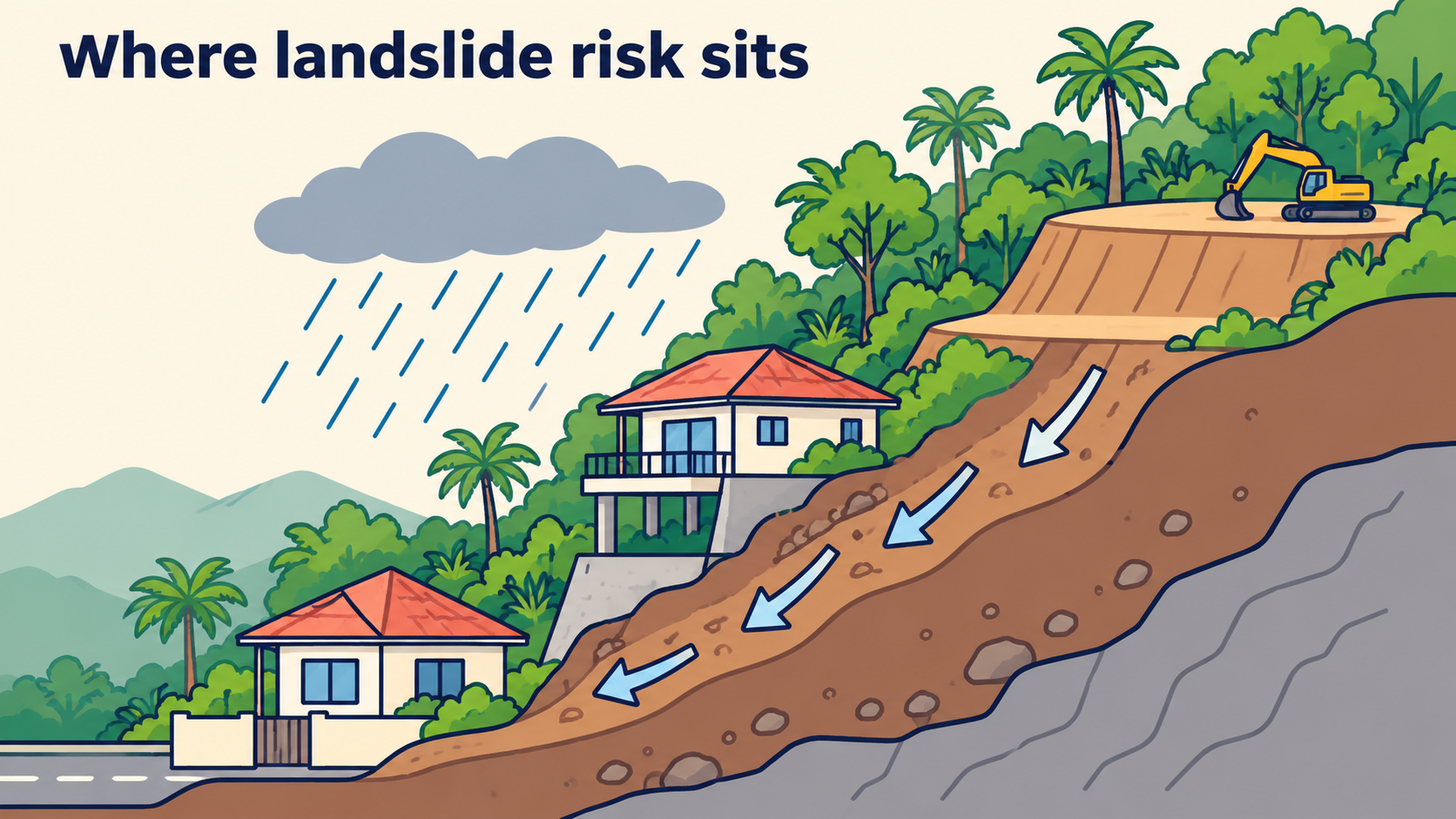
For anyone choosing a home, two points matter more than the blame. First, the slope was already officially rated as high risk. Second, new mapping in 2026 found more high-risk slopes in places with no history of landslides. “It’s never happened here” tells you nothing.
Officials have said about 90% of Phuket’s hills have similar steep terrain. The risk sits on and below steep slopes, especially where they’ve been cut for roads or building. It doesn’t extend across the whole island.
Speed is the other thing to understand. Research models used by officials suggest debris could reach lower ground within four to five minutes. If you get an evacuation alert, go immediately. On 29 October 2026, residents of Patak sois 2, 4 and 6 in Karon received exactly that alert.
How to Check a Rental for Flood and Landslide Risk
No official checklist exists for renters, so this is ours. It’s what we’d check before signing anything.
Visit after heavy rain if you can, or ask to come back after a downpour. Look for water marks on walls, rust on low fittings, sandbags by the door or raised thresholds that someone added later. Compare the floor level with the road outside, and notice whether the house smells damp. Check ceilings, wardrobe corners and bathrooms for mould too, and ask the landlord how they deal with it. I had mould get bad enough in one rental that I had to ask my landlord to sort it out.
Then look around the house. Is there a canal or a big drain nearby? Is the house at the foot of a steep slope, or cut into one? What’s directly above it? Check the access road too, not just the house. A dry house at the end of a road that floods still means a missed school run. Think about the driveway as well. A steep drive up to a sea-view villa is lovely on a dry afternoon and hard work in a downpour, especially with kids.
Ask about flooding, leaks and mould, and don’t only ask the agent. Neighbours and people who’ve lived in the area for a while will tell you how the street copes in October. Then ask the landlord directly who pays for flood damage under the lease, and whether the building is insured.
The street and the estate matter more than the district name. Repeat flooding clusters in particular sois and housing estates. A good area can still have a bad road.
“One of the biggest mistakes families make is choosing a property based on how it looks during a viewing. You might see a beautiful house on a sunny afternoon and have absolutely no idea what happens there during a proper tropical downpour. Leaks, dampness, mould, poor drainage and flooded access roads can turn a lovely property into a daily headache.”
For more on what to look for before you sign, read our guide to renting a house in Phuket and the red flags in long-term rentals.
Day to Day in Rainy Season
Most days, life carries on. You plan around downpours rather than being stuck indoors for weeks. It stays warm, and there’s still plenty of beach time between the showers.
Scooters still work in rainy season, but the roads get slippery and, in my experience, there are more crashes. Thai roads need care at the best of times, and this is when they need the most. If you get caught in a downpour on a bike, find shelter and wait it out. It rarely lasts long. A poncho is non-negotiable, and so are sandals or flip-flops you don’t mind getting filthy. If you’re driving, cars with higher ground clearance cope much better with flooded roads than low ones. Traffic gets slower on heavy days too.
Damp is part of the deal. Clothes take longer to dry, and mould can creep in if a room doesn’t get air. It’s also the time of year when a lot of people seem to get run down, with less sun and changeable weather.
The sea changes more than the land. On the west coast, look for red flags, which mean no swimming. Shallow water that looks calm can still pull you out. Signs on Phuket beaches are in Thai, English, Chinese and Russian, and they’re there for a reason. On 10 and 11 June 2025, two people died off Karon and Kata in conditions like these. In my experience the water also looks noticeably dirtier in rainy season, so pick your swimming days.
Power cuts are common across Phuket, and storms make them more frequent. Mine lasted anything from a few minutes to a few hours. There’s not much you can do except prepare, so keep a power bank charged, and if you’re settling long-term, a generator is worth considering. Report outages to the Provincial Electricity Authority on 1129, or the Phuket branch on 076-210427-8.
For rainy days with kids, we’ve got a list of things to do in Phuket when it rains. For clothes and kit, see what to wear in Phuket.

Dengue in Phuket
Dengue rises with the rain because the mosquitoes that carry it breed in standing water. According to the World Health Organization, they go from egg to adult in about seven to ten days. The best prevention is emptying anything that collects water around your home every week, such as plant pots, buckets and old tyres. Screens, nets and repellent help too.
Phuket’s provincial health office advises seeing a doctor for a high fever and avoiding aspirin and ibuprofen if dengue is possible. Floodwater carries its own risk in leptospirosis, so wear boots and gloves if you have to wade or clean up, and wash with soap afterwards.
Our guide to hospitals in Phuket covers where to go.
Tsunami and Earthquake Risk, in Proportion
These are the risks people worry about most, and the ones least likely to affect your rainy season.
Phuket has 19 tsunami warning towers. They’ve been tested daily since July 2022, and new deep-sea buoys went in during 2024. As of April 2025, three of the 19 were out of service. The phone alert system described below adds another layer of warning. We’ve written about this in more detail in are you scared of tsunami warnings in Phuket?
The Myanmar earthquake in March 2025 was felt by some people in Phuket, about 2,000 km away, but caused no damage here. Local fault lines produce small to moderate quakes, and the most notable recent one, magnitude 4.6 off the east coast in 2015, did no damage.
To put these in proportion: landslides killed 13 people in one night in 2024. Earthquakes have caused no recorded damage in Phuket. A tsunami is a rare, high-impact event, and it’s the one the whole warning system exists for.
Emergency Numbers and Alerts in Phuket
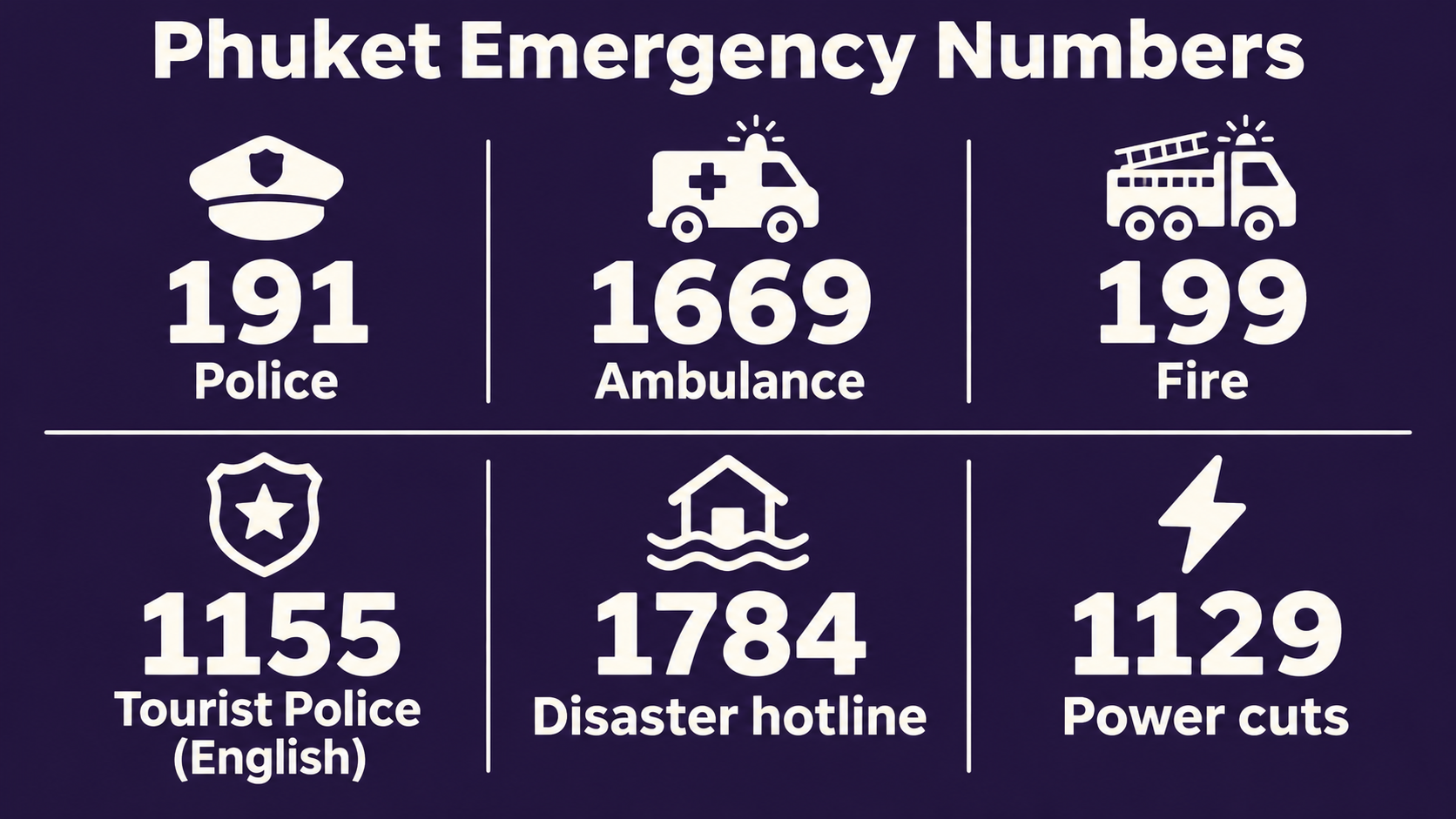
Save these before you need them.
| Number | Service |
|---|---|
| 191 | Police and general emergency |
| 1669 | Ambulance and emergency medical |
| 199 | Fire |
| 1155 | Tourist Police (English-speaking) |
| 1784 | Disaster Prevention and Mitigation (DDPM), also on Line at @1784DDPM |
| 192 | National disaster warning hotline |
| 1129 | Provincial Electricity Authority (power cuts) |
| 076-342600 | Patong Municipality disaster office (24 hours) |
| 076-211111 | Phuket City Municipality disaster office |
Don’t count on English on 191 or 1669. The Tourist Police on 1155 is the line set up for English speakers.
Warnings now reach your phone automatically through Thailand’s Cell Broadcast system. You don’t need an app or to sign up. Alerts go to every phone in the affected area, in Thai and English, and disaster alerts are designed to sound even when your phone is on silent. Phuket was the first province to trial it, in November 2024, and residents received real alerts on 26 and 29 October 2026. I got these alerts while I was living there, warning about local hazards and which areas to stay away from.
Your phone needs to be on 4G or 5G, running iOS 18 or later or Android 11 or later. Check that emergency alerts are switched on in your phone settings. It takes thirty seconds.
When an alert comes in, keep your documents and medicines in a grab bag. Switch off the mains if water is coming in, and keep away from power lines and fast-moving water. If your car stalls in floodwater, don’t restart it. That’s how a flooded engine becomes a write-off, and it can affect your insurance claim.
Flood Insurance and the New Government Scheme
Correct as of 3 November 2026. Policies and government schemes change, so confirm the details with your insurer or the Office of Insurance Commission (hotline 1186) before relying on them.
Since 1 October 2026, the Thai government has paid for disaster insurance covering about 30 million households against flood, windstorm and earthquake. For flood, it pays 10,000 baht upfront and up to 100,000 baht per household per event, depending on the damage. It only pays out in areas the authorities officially declare disaster zones, and tenants with a clear lease are assessed separately from owners.
Two catches matter if you’re renting. The scheme excludes contents, meaning furniture, appliances and air conditioners. And it hasn’t been confirmed whether foreign residents can claim at all. The building is the landlord’s concern. Your belongings are only covered by your own contents policy, and only if that policy includes flood.
For cars, first-class insurance generally covers flood damage. Lower classes usually don’t unless you’ve added flood cover. Check yours before October, not after.
Is the Phuket Rainy Season a Reason Not to Move?
For most families, no. Phuket’s rainy season is predictable. The same months, the same roads and the same risks come round every year, which means you can plan for them.
Choose the house carefully, especially what’s above it. Keep your phone alerts on and your documents in one place, and treat red flags on the beach as rules. Do that, and most of rainy season is an inconvenience rather than a danger.
Honestly, I like rainy season. The island calms down, there’s less buzz and fewer distractions, and it’s a good stretch to focus on work. There’s plenty to do indoors as a couple or with kids. It’s low season too, so prices tend to be lower, which helps if you’re arriving and looking for somewhere to live. The costs are real though. Power cuts, damp, slippery roads and drainage that can’t always cope all come with it, so factor them in when you compare life here with life back home.
“Phuket’s rainy season doesn’t mean it rains all day, every day on the entire island. Even after the heaviest downpours, the water often drains away within an hour or two, and life goes back to normal. We still go to school, work, meet friends, go to the beach and live our lives. Keep an umbrella in the car, adjust your plans occasionally, and you’ll be fine.”
If you’re weighing up areas and want a straight answer on how a specific street or estate copes in the wet, book a consultation. The first 10 minutes are free.
Frequently Asked Questions
What is the rainiest month in Phuket?
September has the most rain by volume, averaging about 350 mm. October has the most rainy days, around 19, and almost as much rain at 336 mm.
How long does the rainy season last in Phuket?
Roughly from mid-May to October, with November still wet but easing off. The dry season usually settles in from December.
Will there be monsoons in Phuket in 2026?
Yes. TMD dated the start of the 2026 rainy season to 15 May. May 2026 was exceptionally wet, and late October brought flash floods in Patong and alerts across the island.
Why is it so rainy in Phuket?
From mid-May, the southwest monsoon pushes moist air in off the Andaman Sea onto Phuket’s west-facing coast. When the winds shift later in the year, the island dries out.
Does Phuket flood every year?
Yes, in the same handful of places. Most flooding is short-lived flash flooding on specific roads and in low-lying estates, and it usually clears within hours.
Which areas of Phuket flood?
The places reported most often are Patong’s Na Nai area, Phuket Town around Bang Yai canal, Kamala, Cherng Talay, the Thepkrasattri and Si Sunthon estates, parts of Chalong and Kathu. It’s usually particular streets, not whole districts.
Is Phuket safe during rainy season?
For most residents, most days, yes. The real risks are flooded roads, landslides on steep slopes, rough seas under red flags and dengue, and each has a clear precaution.
Is there a tsunami risk in Phuket?
It’s rare but real. Phuket has a network of warning towers, deep-sea buoys and phone alerts, and our tsunami guide explains how they work.
What is the emergency number in Thailand?
Call 191 for police, 1669 for an ambulance and 199 for fire. For English-language help, the Tourist Police are on 1155.
Disclaimer
This guide is based on publicly reported information and our own experience of living through rainy season in Phuket. It is not official advice, and Phuket to the Face is not affiliated with or endorsed by any government agency or authority. Weather patterns, flood and landslide risk, emergency procedures, alert systems and insurance rules can change quickly. Always follow instructions from the Thai Meteorological Department, the Department of Disaster Prevention and Mitigation and your local authorities, check for the latest updates before making decisions, and speak to a qualified professional, such as your insurer, about your own situation. Information correct as of 3 November 2026.
Sources
Rainfall and the rainy season
- Thai Meteorological Department, monthly climate summary, May 2026
- WMO climate normals 1991 to 2020, Phuket station 48564
- The Phuket News, Phuket rainfall hits records (November 2025)
- The Nation, Thailand still waiting for official start of winter (October 2026)
Flooding
- The Nation, Phuket homes flooded as 24-hour rain hits 117mm (October 2026)
- The Nation, Phuket red alert for Bang Yai canal (October 2026)
- Khaosod English, heavy rain floods Phuket roads as canal level rises (July 2026)
- Khaosod English, Phuket’s changing landscape contributes to flood challenges (July 2024)
- The Phuket News, officials vet ฿88.5 million in canal projects (April 2026)
Landslides
- Khaosod English, Phuket landslides bury villas and rental houses (August 2024)
- The Phuket News, police drop probe into deadly Kata landslide (June 2025)
- The Phuket News, Karon landslide risk prompts evacuation drill (April 2026)
Health and sea safety
- World Health Organization, dengue and severe dengue
- Khaosod English, Phuket warns swimmers not to ignore red flags (June 2025)
Tsunami and earthquakes
- Bangkok Post, warning system still robust 20 years after tsunami (December 2024)
- The Phuket News, Phuket tsunami warning towers missing or under repair (April 2025)
Emergency numbers and alerts
- Government Public Relations Department, emergency numbers (Thai)
- Thailand.go.th, Cell Broadcast emergency alert system
- The Nation, Phuket disaster alerts and hotlines (October 2026)
Insurance
