

The quick answer
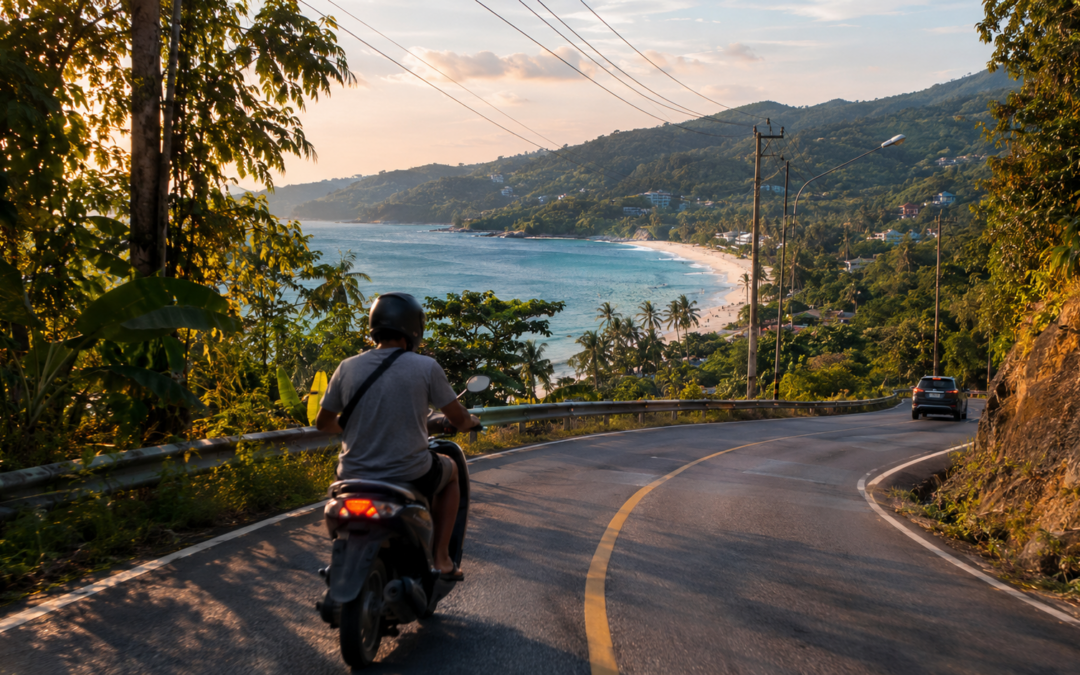
Yes, you can drive in Thailand as a foreigner. For a short stay, your home licence plus an International Driving Permit (IDP) covers you, generally for up to 90 days from entry. If you’re moving here, you’ll need a Thai driving licence, which needs a non-immigrant visa and an appointment at the Land Transport Office in Chalong. In Phuket, most people get around by motorbike, but if you’re a family or you’ve never ridden before, a car is the safer call. And when you first arrive, Grab, bolt or Indrive is the smartest way to get around while you learn the roads
Correct as of 10 November 2026
Table of Contents
✦ Key takeaways
- Your IDP is short-term. It’s commonly accepted for up to 90 days from entry, and some insurers use 60. After that, get a Thai licence.
- Your IDP only covers what your home licence covers. A car-only licence does not make you legal on a scooter.
- You need a non-immigrant visa for a Thai licence. Tourist visas and visa exemptions aren’t accepted, and the rules for foreigners may tighten soon.
- Fines went up and enforcement is stricter. Riding without a helmet can cost up to 2,000 THB per person.
- The roads are dangerous. Ride slowly, expect anything, and don’t learn to ride a motorbike here.
- Start with Grab, then build up. The roads are dangerous, so get around by Grab until your licence is sorted and you understand how traffic works here.
Can you drive in Thailand on your home licence?
For a short time, yes. You need two things together. Your full licence from home, and an International Driving Permit. The IDP is a translation of your licence, not a licence in its own right, so it’s useless without the original.
How long the IDP is valid for depends on who you ask. The commonly accepted position is up to 90 days from your date of entry, though some rental companies and insurers work on 60. Once you’re living here, the expectation is that you switch to a Thai licence.
Get your IDP before you leave home. Thailand accepts both the 1949 and 1968 convention permits, and which one you get depends on your home country. In the UK, IDPs are issued in person at PayPoint stores for £5.50, not at the Post Office. Rules differ from country to country, so check with your own licensing authority which permit you need for Thailand.
Your IDP only covers the vehicle categories on your home licence, and most people miss that. I rode a Honda Click 125 in Phuket for most of a year on my UK licence and IDP, and that was legal because my UK licence includes a motorcycle category up to 125cc. Someone with a car-only licence riding the same scooter is unlicensed. If they crash, their insurance is likely to be worthless.
How to get a Thai driving licence in Phuket
The Thai driving licence is issued by the Department of Land Transport (DLT). In Phuket, that means the Phuket Provincial Land Transport Office.
Who can apply
You need a non-immigrant visa, such as an education, retirement, marriage or work visa. Tourist visas and visa-exempt stamps aren’t accepted for a Thai licence, so if you’ve just arrived on a visa exemption, you’ll be driving on your IDP until your long-term visa is sorted. If you’re still working out which visa you’ll be on, start with our overview of the types of Thailand visas.
If you hold a valid licence from home, you can usually convert it rather than starting from scratch. If you don’t, expect a training course plus theory and practical tests.
The rules may be about to change
The DLT has opened a public consultation, running to 4 December 2026, on draft rules for foreign applicants. The proposals reportedly include removing test exemptions for foreign licence holders, so converting would mean sitting the full theory and practical tests, and requiring a minimum amount of time left on your visa. None of this is law yet. If you’re planning to convert your licence, it may be worth doing it sooner rather than later, and we’ll update this guide when the DLT confirms what happens.
The documents you'll need
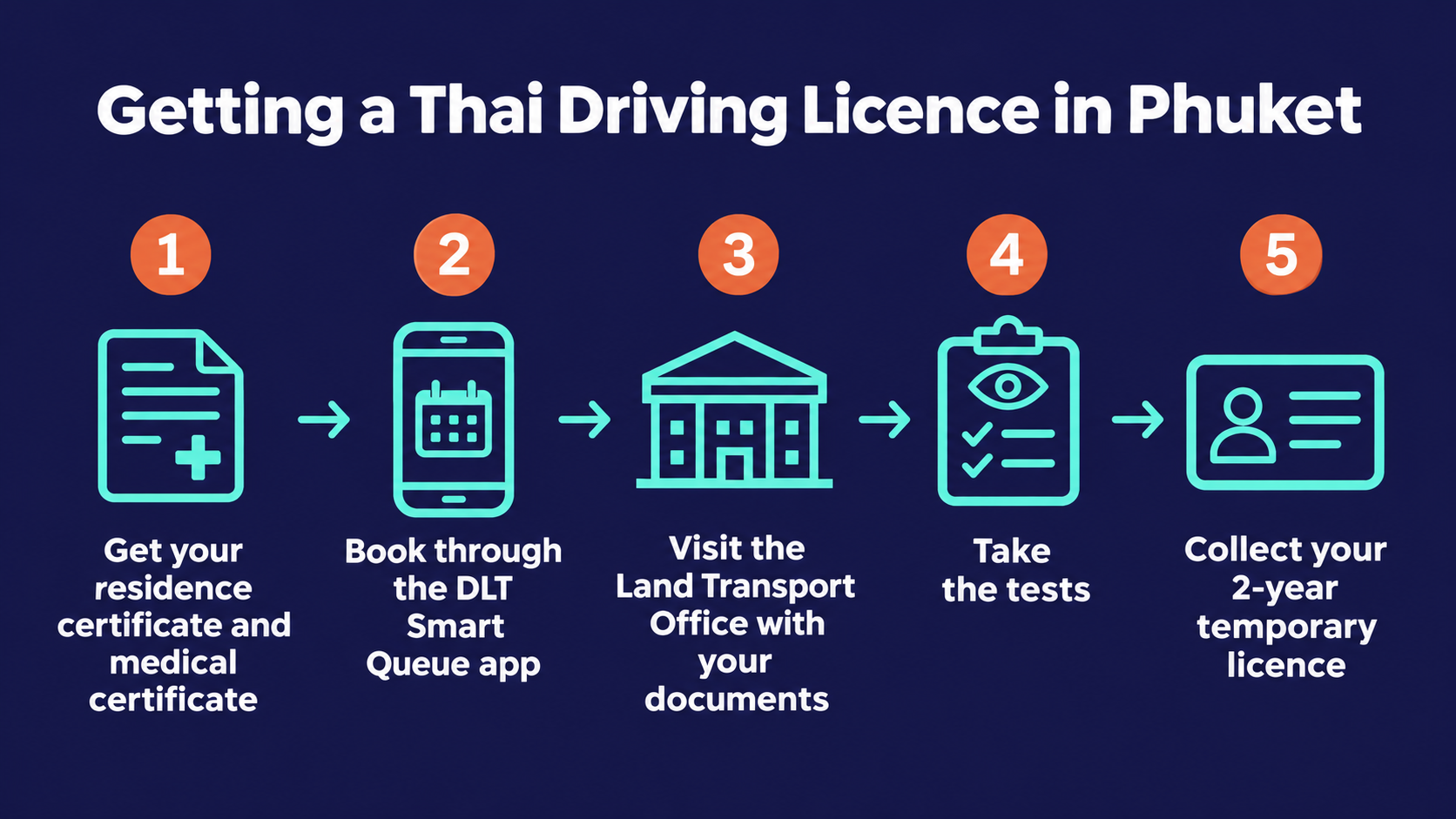
Bring your passport with your non-immigrant visa, your home licence and IDP, and proof of address. That’s usually a residence certificate from Phuket Immigration, though a valid work permit can also work. You’ll also need a medical certificate from a Thai clinic or hospital, and the certificate showing you’ve completed the DLT’s online e-learning. Photocopies of your passport photo page and visa page are worth having too.
Timing matters. The residence certificate and the medical certificate are both generally valid for around 30 days, so get them just before your appointment, not weeks ahead.
The medical certificate is quick. Most clinics will do one in a few minutes for a small fee. Tell them it’s for a driving licence.
Booking your appointment
You book appointments through the DLT Smart Queue app, which is also where you do the e-learning and get the QR code you’ll need on the day. Book early. Slots at the Phuket office can be weeks or even months away, and that wait matters if your IDP window is closing.
The tests
Everyone takes the physical aptitude tests. These cover colour vision, depth perception, peripheral vision and brake reaction time.
If you’re converting a valid foreign licence, the practical driving test is usually waived for the same vehicle category. The theory test depends on the office. Some waive it if you hold a valid foreign licence or IDP, others ask you to sit the 50-question multiple-choice exam, which is available in English and needs 45 correct answers to pass. Go prepared for it either way.
If you have no licence at all, you’ll need to complete the training course and pass both the theory and practical tests.
Costs
The DLT fees are low. A two-year temporary car licence costs 205 THB, and the five-year licence 505 THB. For a motorbike, it’s 105 THB for the temporary licence and 255 THB for five years. On top of that, a medical certificate is usually 100 to 300 THB, and a residence certificate around 200 to 500 THB.
Temporary licence, full licence and renewal
Your first Thai licence is a temporary one, valid for two years. Before it runs out, you renew it for a five-year licence. Keep an eye on the expiry date and book the renewal well ahead, because the appointment backlog applies to renewals too.
Getting a Thai motorbike licence
A car licence and a motorbike licence are separate categories in Thailand. If you want to ride legally on a Thai licence, you need the motorbike category on it, not just the car one.
This is the licence foreigners skip most often, and it’s the one that matters most in Phuket, because that’s what most people ride. The process runs through the same office with the same documents. If your home licence covers motorcycles, you can usually convert that category too.
Helmets are compulsory for both the rider and the passenger. Riding without one can cost up to 2,000 THB, and that doubles when neither of you is wearing one.
Car or motorbike in Phuket?
Public transport in Phuket is minimal. Unless you’ve got the budget to take taxis everywhere, you’ll need your own wheels, and for most people that means a motorbike.
Most people rent a scooter monthly from a local shop. When I lived here in 2025 and 2026, my Honda Click 125 cost around 3,000 to 4,000 THB a month. Shops usually ask for a deposit, either cash or your passport. Your passport is the one thing you can’t be without here, so offer a cash deposit if you can.
| Motorbike | Car | |
|---|---|---|
| Monthly cost | Low | Much higher |
| Parking | Easy almost everywhere | Harder in Patong and the busy beach areas |
| Traffic | Filters through queues | Sits in them |
| Safety | High risk, especially for new riders | Much safer |
| Rain | Slippery roads, you get soaked | Dry, safer grip |
| Kids and shopping | Not really | Easy |
| Heat | Hot at lights, breezy moving | Air conditioning |
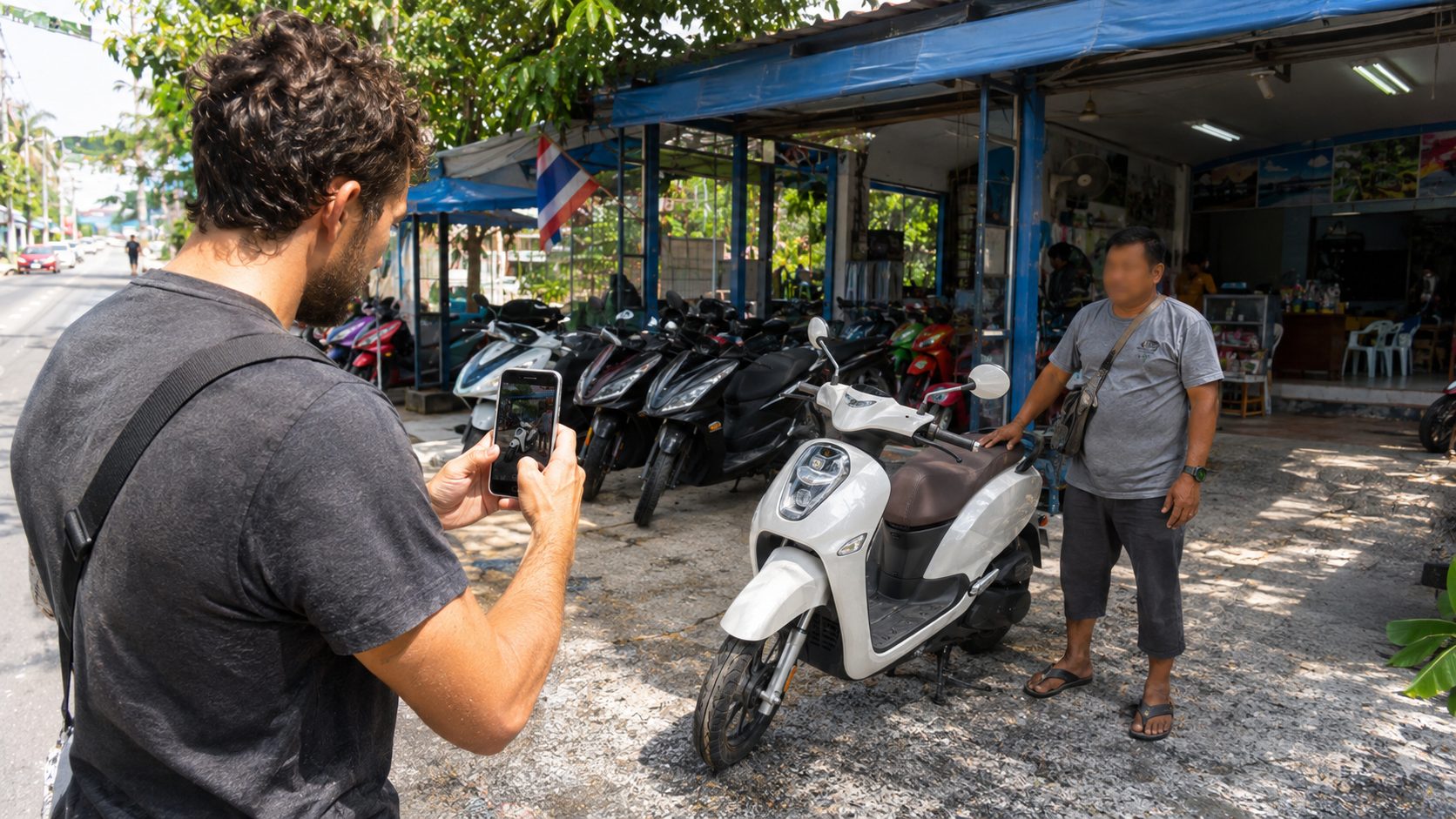
Before you ride away, film the vehicle. Walk slowly around the whole bike or car with your phone recording, with the owner there, and get close on every scratch, dent and scuff. Check the tyres, brakes, lights and mirrors, and note the fuel level and mileage. Some shops will try to charge you for damage that was already there when you collected it, and a time-stamped video settles that argument in seconds. Do the same again when you hand it back.
Which is better in rainy season?
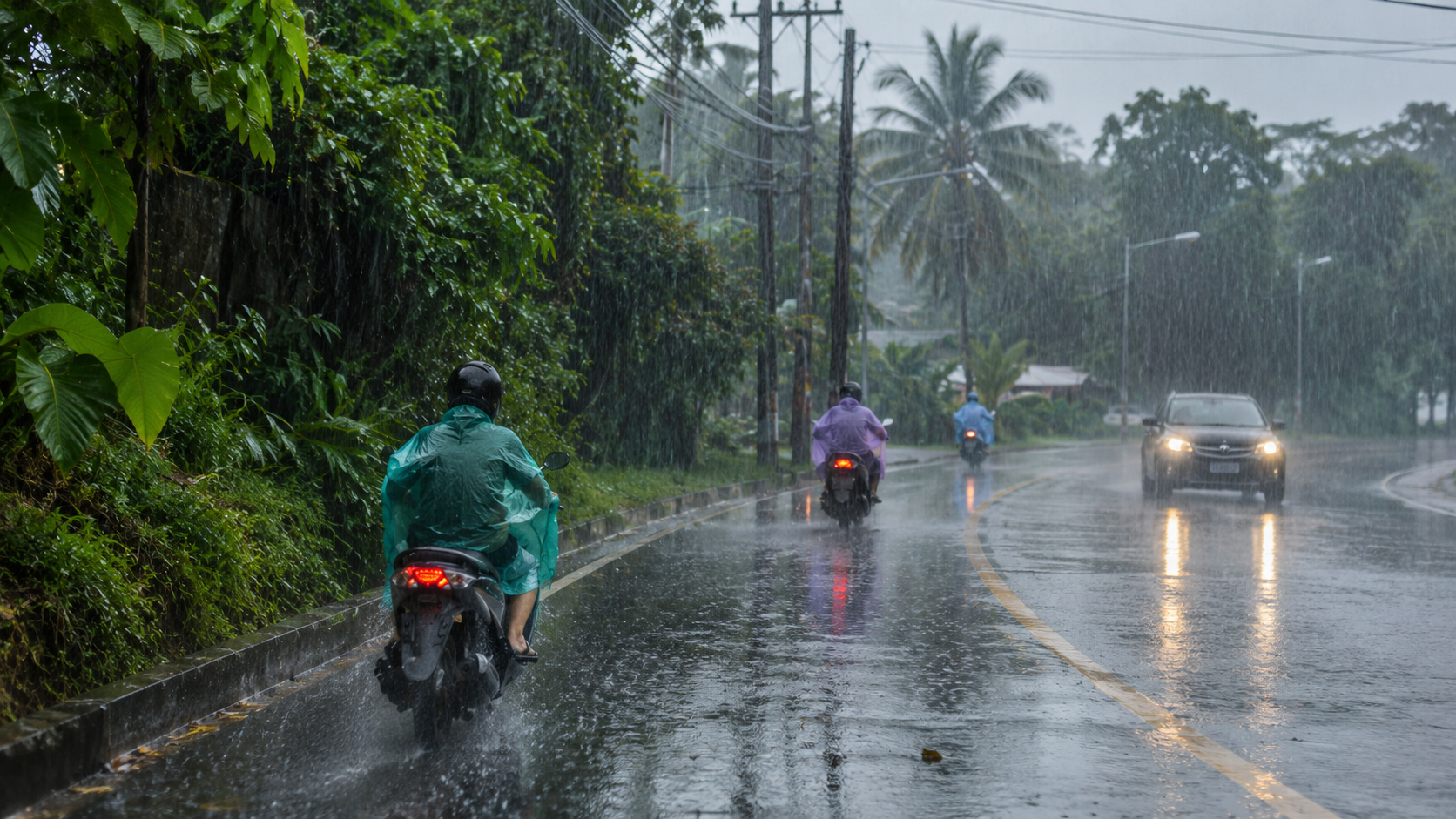
A car, every time. In rainy season the roads get far more slippery, and from what I saw, people come off their bikes much more often. Foreign riders who don’t understand the conditions are the ones most likely to crash. Add flash flooding on low roads and poor visibility in heavy downpours, and a bike stops being the easy option. Read our guide to rainy season flooding in Phuket before your first wet season.
If you’re on a bike and the sky opens, the sensible move is often to pull in and wait it out.
The honest safety picture
Thailand’s roads are among the most dangerous in the world. The World Health Organization put Thailand’s road death rate at 25.7 per 100,000 people in 2021, against a global average of 15, and around three-quarters of road deaths involve motorcycles. Every year there are fatal crashes on Phuket’s roads too.
If you’ve never ridden a motorbike before, Phuket is not the place to learn. If you do ride, check that your health insurance covers motorbike accidents and what licence it expects you to hold.
Your First Few Weeks, start with Grab
When you first arrive, don’t rush onto the roads. Your licences won’t be sorted yet, and you won’t know how traffic works here. Use Grab to get everywhere in the beginning. Families should book Grab cars. For solo trips, a Grab bike is quick and cheap, with a local rider doing the riding. Our guide to the best taxi apps in Phuket compares Grab, Bolt and the rest.
Those first weeks in the passenger seat are useful. You’ll see how the roundabouts work, where the bikes come from and how the hill roads feel, without being the one in control. Once your licence is sorted and you’re comfortable with how the roads work, make the move to driving yourself.
What driving in Phuket is like day to day
Hazard lights are used to let people out, which is new if you’re from the UK. Flashing headlights means the opposite of what it does back home. Here it means “I’m coming through, get out of the way”. Bikes undertake and overtake constantly, filtering in and out on both sides of you. Nobody lets you out at roundabouts. The rules exist, but on the road it often feels like there aren’t any.
The best advice is to go with the flow the way the locals do, and be very careful while you do it. Ride slower than you think you need to. Leave room for the unexpected, because it will happen. Check your blind spots constantly, since there’s almost always a bike in them.
“The best advice is to go with the flow the way the locals do, and be very careful while you do it. Ride slower than you think you need to. Leave room for the unexpected, because it will happen. Check your blind spots constantly, since there’s almost always a bike in them.”
The hill roads between the beaches are where I’d be most careful. They’re steep and winding, and in our experience they’re where inexperienced riders get into trouble, especially in high season when the island is full of first-time riders.
Traffic is worst around Chalong, Patong and Cherng Talay, and the run to the airport through Phuket Town at rush hour is slow going. Of the areas I’ve lived in, Rawai was the easiest to get around by bike. If you’re still choosing where to live, our guide to Phuket’s neighbourhoods covers how each area works day to day.
Police checkpoints are common across the island. Expect them at places like the Chalong roundabout and on the roads out of Patong and Karon, as well as in the main towns. They mostly check for helmets and licences. Carry your licence and IDP every time you ride.
This video does a good job of explaining Thai road etiquette if you want to see it in action before you arrive.
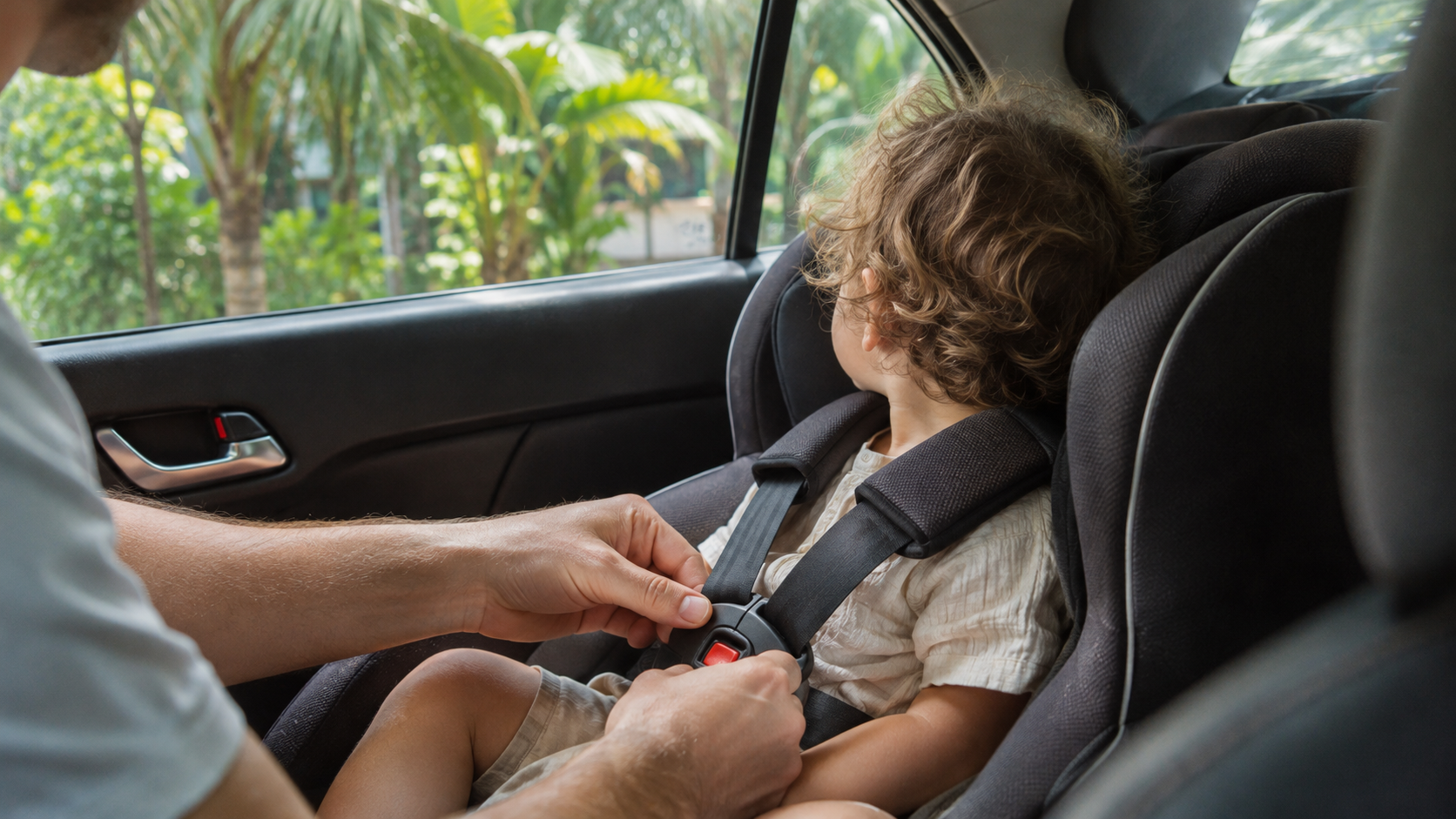
Driving with kids in Phuket
Since September 2022, Thai law requires children under six to ride in a child safety seat or booster seat, with a fine of up to 2,000 THB. Seat belts are compulsory for everyone in the car, front and back. Enforcement varies, but the law exists for a reason, so bring or buy a proper seat.
You’ll see whole families on one motorbike here. It’s normal locally, but it isn’t safe. With more people on a bike, a crash is more likely to be serious and to injure more of them. If a family car fits your budget, get one.
School runs add their own traffic. Factor the drive into your choice of school and area, and see our guide to international schools in Phuket for where the main schools are.
Rent, buy or skip the car?
If you’re staying long term, you’ll eventually choose between a long-term rental and buying. A long-term rental keeps things simple while you settle in and work out which area you’ll stay in. Buying second hand usually makes more sense once you know you’re staying. We get asked about this a lot, so we’ve written about finding a family car in Thailand. If you’re renting, film the car before you drive off, the same way you would a bike.
Whichever you choose, check exactly what insurance comes with the car and what it covers, and make sure your licence situation matches what the insurer requires.
If you’d rather not drive at all, Grab works well across most of the island. For solo trips, a Grab bike is quick and cheap. For families, book a Grab car.
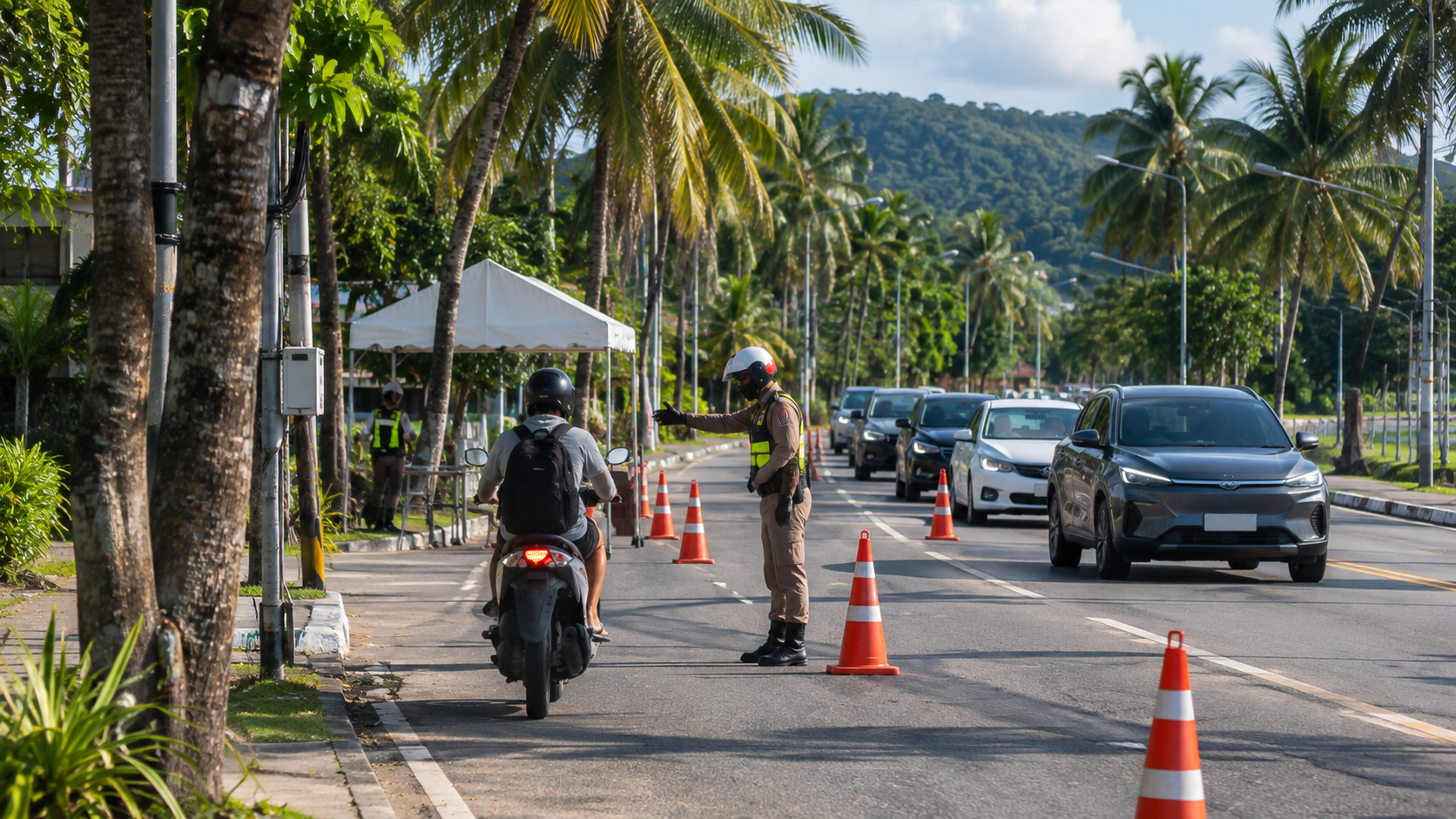
Thai traffic fines you should know about
Thailand raised its traffic fines under the 2022 Land Traffic Act, and police launched a crackdown on ten major offences from 1 April 2026. These are the maximum fines.
| Offence | Maximum fine |
|---|---|
| Speeding, running a red light, not stopping at a pedestrian crossing, using a phone without hands-free | Up to 4,000 THB |
| No helmet (rider or passenger) | Up to 2,000 THB |
| Not wearing a seat belt | Up to 2,000 THB |
| Driving against the traffic | Up to 2,000 THB |
| Not carrying your driving licence | Up to 1,000 THB, plus possible imprisonment of up to one month |
| Drink-driving | 5,000 to 20,000 THB, plus up to one year in prison |
Thailand also runs a 12-point licence system. Offences cost points, and lose them all and your licence is suspended.
Frequently Asked Questions
Is driving in Phuket difficult?
It’s chaotic rather than difficult. Bikes come at you from every side, the hill roads are steep and the local road habits take getting used to. Drive slowly and defensively and it’s manageable.
Can I drive in Thailand on a tourist visa or visa exemption?
Yes, on your home licence plus an IDP, generally for up to 90 days from entry. You can’t get a Thai licence on a tourist visa or visa exemption, though. That needs a non-immigrant visa.
How long can I drive on an international driving permit in Thailand?
Generally up to 90 days from entry, though some insurers and rental companies use 60. After that, you should get a Thai licence.
Is it easy to get a Thai driving licence?
If you have a non-immigrant visa, a licence from home and the right paperwork, it’s mostly a matter of booking an appointment and passing a few short tests. The hard part is often getting an appointment. Draft DLT rules could make it harder for foreigners, so check the latest before you go.
How much does a Thai driving licence cost?
The DLT fee is 205 THB for a two-year temporary car licence or 105 THB for a motorbike. Five-year licences cost 505 THB for a car and 255 THB for a motorbike. Add 100 to 300 THB for the medical certificate and around 200 to 500 THB for a residence certificate.
What documents do I need for a Thai driving licence?
Your passport with a non-immigrant visa, your home licence and IDP, a residence certificate or work permit, a medical certificate issued within about 30 days, and your DLT e-learning certificate.
What happens if you drive without a licence in Thailand?
You can be fined at a checkpoint, and if you crash, your insurance is unlikely to pay out. The insurance is the bigger problem.
Should new arrivals drive straight away?
No. Use Grab for the first few weeks, cars for families and bikes for solo trips, while your licence gets sorted and you learn how the roads work. Then start driving once you’re comfortable.
How do I avoid being charged for damage on a rental bike or car?
Film a slow walk-around video of the whole vehicle with the owner present before you leave, get close on every existing scratch and dent, and film it again when you return it.
Moving to Phuket and still working out the logistics?
Getting around is one piece of a much bigger move. Book a free 10-minute call with Inbar and get your questions answered by someone who’s lived here for seven years.
Our relocation course covers daily life in Phuket, including getting around, alongside where to live, schools, visas and costs.
Sources
Licence rules, fines and road safety figures in this guide come from the sources below, checked in November 2026. Rules change, so always confirm with the DLT before you apply.
- Department of Land Transport, official website. dlt.go.th
- GOV.UK, “Driving abroad: get an international driving permit (IDP)”. Read it
- Malay Mail / AFP, “Explainer: Why are Thailand’s roads so deadly?”, October 2024 (WHO road death figures). Read it
- UCA News, “Thailand’s road toll comes at too high a price” (WHO data on motorcycle deaths). Read it
- Thai PBS World, “Kids under 6 in cars in Thailand must be secured in child seats from September”. Read it
- Nation Thailand, “Thailand to strictly enforce 10 key traffic offences from April 1”, 2026. Read it
- Thaiger, “10 Thailand’s traffic offences that could cost you fines or jail”, 2026. Read it
- The Star, “Bikers without helmets in Thailand face up to THB 2,000 fine”, May 2025. Read it
- Thairath, “Summary of New Traffic Laws: Latest Fines and Penalties”, March 2026 (licence points system). Read it
- Thaiger, “How well does your international driving permit work in Thailand?”, March 2026. Read it
- Thaiger, “A foreigner’s guide to getting a Thai driver’s license in Thailand”. Read it
- Real Life Phuket, “Freedom to explore”, February 2026 (DLT Smart Queue app). Read it
- The Phuket News, “Phuket police target unlicensed drivers” (Land Transport Office appointment waits). Read it
- ISSA Compass, “Thailand Driver’s Licenses for Foreign Residents: Conversion Rules by Visa Type in 2026”, October 2026. Read it
- Byklo, “Thai Driving License Requirements 2026: Costs & Tests” (DLT fee breakdown). Read it
