

Short answer – for most families relocating to Phuket, a bilingual or international school is the better fit. In practice, Inbar almost never recommends a Thai school, and only does so in very special circumstances: younger children, families settling into Thai life for the long term, or households with a Thai parent. This guide walks through which of the three fits your family.
If you are moving to Phuket with children, one of the biggest decisions you will make is not where you live, but where they go to school. The honest answer to “Thai or international?” is that it is the wrong question. There is a third option most families end up weighing, and the right choice depends far more on your child than on the name above the school gate.
Table of Contents
✦ Key takeaways
- There are three options, not two. Thai, bilingual or English Programme, and international. The bilingual middle is where many foreign families realistically land.
- For most families, bilingual or international is the recommendation. In practice Inbar almost never advises a Thai school unless the circumstances are special.
- A Thai school suits a narrow profile. Younger children, long-term or Thai-background families, and those genuinely wanting Thai-language integration.
- The older the child, the more the exit plan matters. Switching systems later is possible but needs planning, especially academic English.
- Cost matters, but it is not the whole decision. Thai and bilingual are cheaper; still judge on fit and full cost, not the price tag or the campus.
There are three options, not two
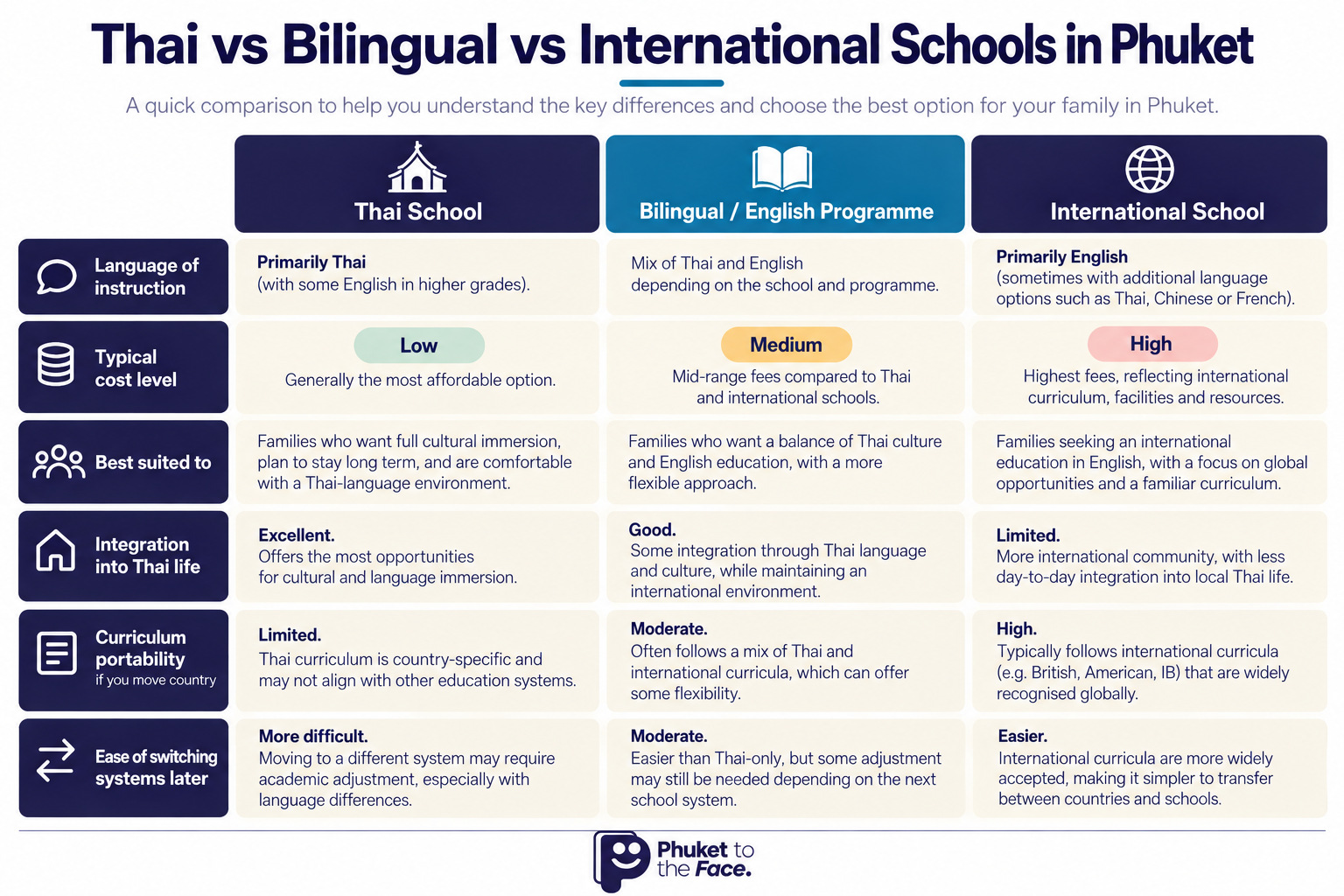
Most families arrive thinking the choice is Thai school or international school. In Phuket, the more useful way to look at it is three categories, because there is a middle ground that a lot of foreign families end up choosing: Thai bilingual and English Programme schools.
The starting point catches a lot of people off guard: foreign children can legally attend Thai schools, and you do not need to own property in Thailand for them to do so. But being allowed to attend and a school being a realistic fit for your child are two different things. A child who does not speak Thai can find a regular Thai-language programme tough going, and it gets tougher the older they are. That is where bilingual and English Programme schools come in. For a lot of foreign families, they are the realistic middle ground between a full Thai education and a full international one.
Enrolment requirements, documentation and the rules around them can change and vary from school to school. The general position above is correct as of October 2026. Confirm the current specifics directly with the school and the relevant authorities before you rely on them.
Start with these questions
Before you compare any schools, it helps to answer a few questions about your own family. These are the ones that genuinely shape the decision:
- How old are your children?
- What language do they currently study in?
- How long are you planning to stay in Thailand?
- Where do you think they will be studying in two to three years?
- Socially, your child may have few or no other foreign children in the class, let alone the school. Will they be comfortable with that?
- And if you are leaning towards a Thai school, why? Often the honest answer is cost, and that is a completely fair reason, as long as you go in with your eyes open.
Your answers to these matter more than any brochure. A choice that is right for a five-year-old staying long term is often wrong for a twelve-year-old who may move again in a couple of years.
Who does well in a Thai or bilingual school, and who should be careful
This is where a Thai or bilingual school genuinely fits, and in practice it is a small minority of the families Inbar sees. For most, she steers towards bilingual or international.
Younger children have far more room to adapt, especially in preschool and early primary. The language comes more easily at that age, and there is less academic ground to make up. A Thai or bilingual school can work really well for families who genuinely want their kids to learn Thai and settle into Thai life, who plan to stay for years, or who have a Thai background and or a Thai parent. And it can make a serious dent in your costs. With three school-age children, your choice of school can change your whole family’s cost of living in Phuket.
It is a riskier call with older children who have already spent years in another system, especially if you know you might leave Thailand again before long. Putting a four-year-old into a bilingual programme is a very different decision from putting a twelve-year-old into one and expecting them to slot into a British, IB or American secondary programme later. The older the child, the more the exit plan matters.

What parents underestimate
Language is the obvious one. The less obvious, and often bigger, one is culture. A Thai school is a cheaper international school only on the surface. The teaching style, the expectations, how the school communicates with parents, the hierarchy, the discipline, the curriculum and the wider school culture can all be different, and noticeably so if your reference point is a Western school.
The other thing parents underestimate is that “bilingual” means very different things from one school to the next. A school offering roughly 30% English and 70% Thai, or the other way round, can be a good option, but the label alone tells you almost nothing. Before you commit, ask:
- How much of the day is genuinely taught in English?
- Which subjects are taught in English?
- Who teaches them, and are they native speakers?
- What curriculum is the school following?
- What will your child’s academic English look like after several years there?
Why "international" is not automatically better
No, it is not. Phuket’s international schools sit at completely different levels, price points, curricula and academic standards. The label on the gate is not the thing to judge them by.
Parents get very impressed by facilities and campuses. A beautiful swimming pool and a full-size football field tell you very little about whether your child will be happy there, or whether the teaching style suits them. Sometimes a smaller bilingual school is a much better environment for a particular child than a glossy international one.
“International on the sign doesn’t tell you whether the school is right for your child”
Phuket International Schools
If you want a quick visual overview of the major brand names that come up during your initial research, this brief clip lists several popular campuses across the island.
Seeing a name on a video list only gives you the high level picture. Matching a school to your child learning style and your budget requires a much deeper look.
How much your child's age changes the answer
A lot. The younger the child, the more flexible the options.
Nursery and kindergarten is one conversation. Primary is another. Secondary is a different matter entirely, because of the language and the social side, but also the curriculum, what came before it and what needs to come after. The older the child, the more important the exit plan becomes, and the less room there is to experiment.
Starting Thai or bilingual, then moving to international later
Yes, this is a real path, and it works most readily with younger children. What you should not assume is that the transition will be seamless. What you need to check is whether your child will be academically ready for the year group they are moving into, and that means academic English, writing, maths terminology and the specific curriculum ahead of them.
If the plan from day one is to move into an international school later, choose the Thai or bilingual school with that future move in mind, rather than discovering the gap when you get there.
The real cost picture
This is where the difference can become enormous. In Inbar’s experience, international school fees in Phuket range widely, from lower-cost schools at around 200,000 THB a year up toward or beyond 1,000,000 THB per child per year at the top end.
Those figures are tuition only. They do not include application and assessment fees, registration and enrolment fees, deposits, capital or development fees, uniforms, books and devices, lunches, buses, trips, extra-curricular activities or exam fees, and these vary from school to school. Thai and bilingual schools can be dramatically cheaper, but the same rule applies: look at the full annual cost, not just the advertised tuition.
Then multiply everything by the number of children you have. With three school-age kids, your choice of school becomes one of the single biggest financial decisions in your whole relocation.
Fee figures above are a general guide based on Inbar’s experience across Phuket schools, not a fixed price list. Confirm current fees and the full cost breakdown directly with each school.
Does choosing Thai or bilingual close doors later?
No. But it helps to separate possible from easy. Children move between systems all the time. What decides how smoothly it goes is their age, their academic level, their English level, which curriculum they are moving into and how much bridging they will need to get there.
University is a long way down the road, and by then what matters is which qualifications your child graduates with and the entry requirements of the universities they are applying to. A Thai or bilingual start does not shut that down. It just means planning the path rather than assuming it.
Where families go wrong
The three mistakes that come up most often:
- Choosing on price alone. Sometimes budget genuinely is the deciding factor, and that is fair. The trap is letting it be the only thing you look at.
- Choosing on the campus. An impressive site does not guarantee the school meets the standards you need, or suits your child.
- Choosing because another family loves it. A school that is perfect for someone else’s child may not be right for yours. Always visit before you decide.
The common thread: the right school is the one that fits your child, your timeline and your budget, not the one that photographs best or comes most recommended.
How to decide
Start with your own family, not the schools. Pin down your children’s ages, the language they study in now, how long you realistically expect to stay, and where you want them to be in two to three years. Then shortlist schools across all three categories, Thai, bilingual and international, that fit those answers and your budget, and visit every one before you commit.
If you want a shortcut, this is exactly what a consultation is for. Inbar has personally visited every international school on the island, so she can give you a straight read on any school you are weighing, and point you towards the ones worth your time. The first ten minutes of a consultation are free, which is often enough to answer a couple of specific questions. If you need the deeper dive, you can book a full session from there.
If you would rather work through it in your own time, the relocation course covers schooling in detail alongside visas, costs and daily life.
Frequently Asked Questions About Thai vs International School Phuket
Can foreign children attend Thai schools?
Yes. Foreign children can legally attend Thai schools, and you do not need to own property in Thailand for them to do so. Whether a particular school is a realistic fit, especially for a child who does not speak Thai, is a separate question. Confirm current enrolment requirements directly with the school.
What is a bilingual or English Programme school?
It is a Thai school that teaches part of the day in English, often somewhere between 30% and 70%. How much English, which subjects, and whether the teachers are native speakers varies a great deal, so ask each school directly rather than relying on the label.
Is a Thai school much cheaper than an international school?
Usually, yes, often dramatically so. But compare the full annual cost, including enrolment fees, deposits, uniforms, transport and extras, not just advertised tuition. International fees in Phuket range from roughly 200,000 THB a year to over 1,000,000 THB per child at the top end.
Can my child switch from a Thai or bilingual school to an international school later?
Yes, and it is a common path, especially with younger children. The move goes more smoothly when you have planned for it, so the child is academically ready, particularly in English, for the year group they are entering.
What age is too late to start a child in a Thai school?
There is no hard cut-off, but the younger the child the easier it is. The older they are, and the more years they have spent in another system, the more the language, social side and exit plan need thinking through.
